Why Washing Machines Fail in Low Water Pressure Indian Homes (Borewell & Tank Reality)
Low water pressure is one of the most common but least discussed problems in Indian homes. From borewell supply to overhead tanks and irregular municipal water timing, many households do not get continuous or stable water flow.
Yet most washing machines sold in India are designed assuming steady pressure, something that rarely exists outside ideal city conditions. When pressure drops, the machine doesn’t simply “wash slower” it starts misbehaving in ways most users don’t immediately connect to water supply.
Repeated wash cycles, incomplete rinsing, detergent residue on clothes, sudden pauses during wash, and even error codes are often blamed on the machine. In reality, the root cause is a mismatch between how washing machines are designed and how Indian homes actually receive water.
This article explains what really happens inside a washing machine when water pressure is low, why certain designs struggle more than others, and what Indian households should understand before repairing or replacing a machine.This issue of washing machine low water pressure is especially common in Indian homes using borewell or overhead tank water supply.
Why Washing Machine Low Water Pressure Is Common in Indian Homes
In Indian households, water pressure depends on multiple factors that are often outside the homeowner’s control. Borewell depth, pump capacity, overhead tank height, shared pipelines, and water timing all influence how much pressure reaches the washing machine inlet.
Apartments may face pressure drops during peak morning hours, while independent houses using borewells often experience inconsistent flow depending on groundwater levels. Seasonal changes make the situation worse, especially during summer when tank refilling becomes irregular.
Unlike Western homes where pressurised supply is standard, Indian homes rely heavily on gravity-fed systems. This difference alone explains why washing machines that work flawlessly in showrooms behave unpredictably after installation.
What Actually Happens Inside a Washing Machine When Water Pressure Is Low
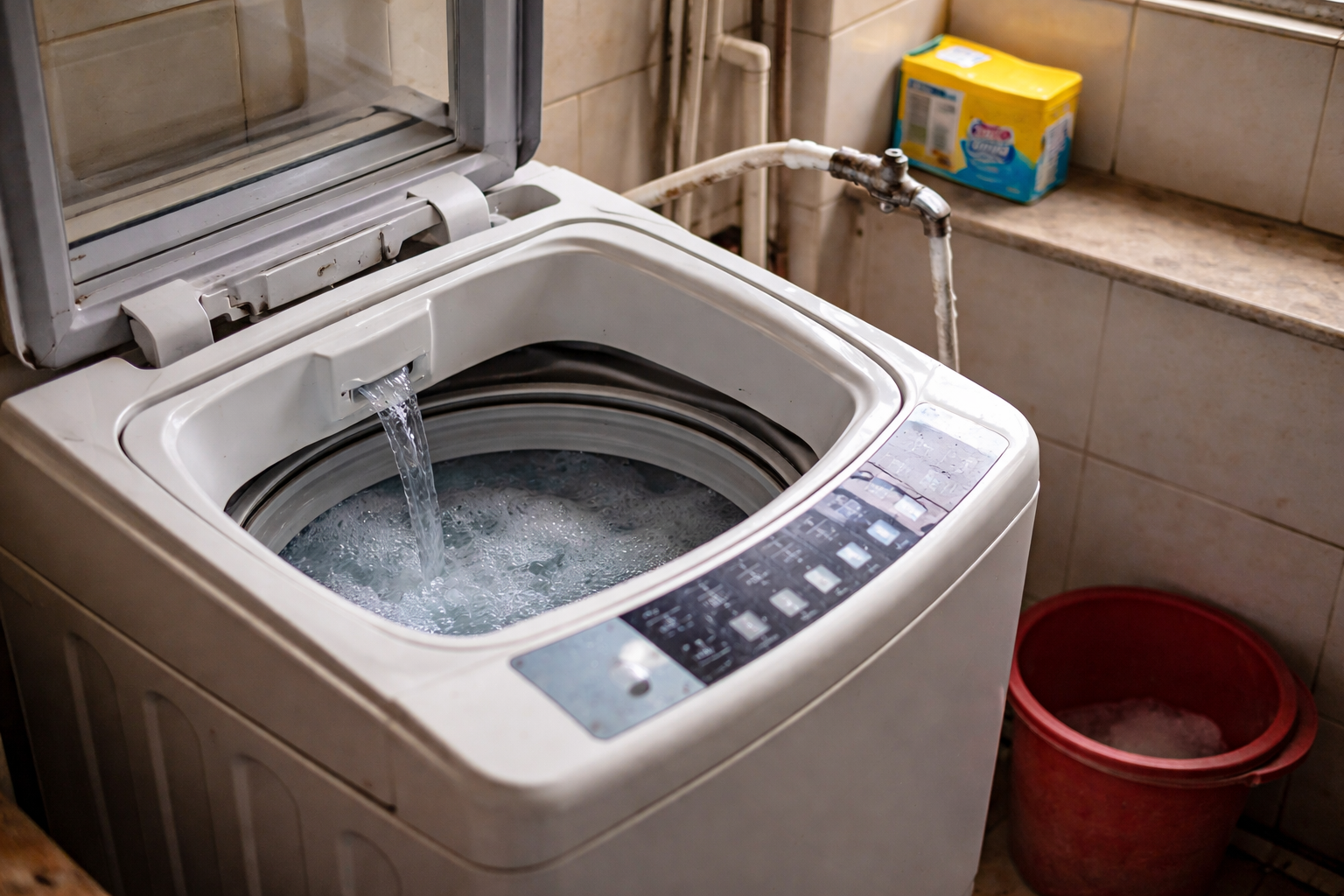
Modern washing machines are controlled by sensors that monitor water intake volume and timing. When water pressure is low, the machine struggles to reach the required water level within a fixed time window.
As a result, the machine may pause mid-cycle, repeatedly try to refill water, or extend wash duration automatically. In some cases, it may proceed with insufficient water, leading to poor agitation and ineffective cleaning.
This internal confusion increases strain on valves and motors, causes uneven detergent mixing, and leads to incomplete rinsing. Over time, this pattern silently reduces both wash quality and machine lifespan.
Hidden Problems Caused by Low Water Pressure That People Ignore
Many users accept repeated wash cycles as normal without realising that each extra cycle increases water usage, electricity consumption, and wear on the machine. Clothes may feel stiff after drying, not because of detergent quality, but due to improper rinsing.
Low pressure also encourages detergent residue buildup inside the drum and pipes. Over time, this leads to unpleasant odour, bacterial growth, and frequent service calls that are wrongly blamed on manufacturing defects.
These issues develop gradually, which is why most people do not connect them directly to water pressure until the problem becomes expensive.
Why Brand Recommendations Often Fail in Borewell and Tank Supply Homes
Most brand guidelines are based on ideal testing conditions with consistent water pressure. While manuals mention minimum pressure requirements, they rarely explain what happens when homes fall below those levels.
Sales advice often focuses on capacity, star ratings, and programs, without evaluating actual water delivery conditions. This gap between showroom advice and household reality leads to disappointment after purchase, even when the machine itself is technically sound.
Which Washing Machine Designs Handle Low Water Pressure Better in Indian Homes
Not all washing machines react to low water pressure in the same way. The difference lies more in internal design logic than in brand name or price.
Machines that rely heavily on timed water intake struggle the most when pressure fluctuates. These machines expect a certain amount of water to enter within a fixed time. When that doesn’t happen, cycles pause, reset, or stretch endlessly.
Designs that allow longer intake windows and adapt wash motion based on actual water level tend to cope better. This is why some machines appear “patient” while others feel overly sensitive in the same household.
Another overlooked factor is inlet valve tolerance. Some valves are designed to open wider under low pressure, while others are optimised only for steady supply. Unfortunately, this information is rarely communicated clearly to buyers.The difference lies more in internal design logic than in brand name or price.
Top Load vs Front Load Washing Machines in Low Water Pressure Conditions
In low water pressure homes, the difference between top load and front load machines becomes more pronounced.
Top load machines generally rely on gravity and volume rather than pressurised spray. This makes them more forgiving when water enters slowly. Even if intake takes longer, the wash process can still proceed with acceptable results.Front load machines are more efficient by design, but they depend on precise water dosing. When pressure drops, their efficiency advantage can turn into a weakness, leading to repeated intake attempts and extended cycles.
This does not mean front load machines are unsuitable for all Indian homes. It simply means their performance depends more heavily on stable installation conditions and water delivery consistency.
Why Overhead Tank Height Matters More Than People Realise
Many Indian homes assume that having an overhead tank automatically solves water pressure issues. In reality, tank height plays a critical role.
If the vertical distance between the tank and the washing machine inlet is insufficient, gravity alone may not generate enough pressure. This is especially common in single-storey houses and low-rise buildings.
Long horizontal pipelines, multiple bends, and shared outlets further reduce effective pressure by the time water reaches the machine. Even a good washing machine struggles under these physical limitations.
Understanding this basic physics helps homeowners diagnose problems correctly instead of blaming the appliance.
Common way to Fixes Indian Households Try for Low Water Pressure And Why Many Fail
When washing machines start misbehaving, many households try quick fixes without understanding the root cause.Installing external pumps is one common attempt. While pumps can help, improper installation often creates inconsistent pressure surges that confuse machine sensors rather than stabilising intake.
Another frequent fix is reducing load size. This may temporarily improve wash quality but does not address intake timing issues. Over time, the machine still experiences stress.
Changing detergents or wash programs also rarely solves pressure-related problems, yet these changes are often suggested during service visits because they avoid addressing installation limitations.
Practical Steps to Improve Washing Machine Performance in Low Pressure Homes
Before considering replacement, several practical adjustments can significantly improve performance.
Raising overhead tank height, even by a small margin, can increase gravity pressure noticeably. Ensuring a direct water line to the washing machine instead of sharing it with other taps also reduces pressure loss.Cleaning inlet filters regularly prevents further restriction of already limited flow. Many pressure issues worsen simply due to clogged filters that go unnoticed.
Using wash programs that allow longer soak times gives the machine more flexibility to work with slow intake, reducing repeated pauses and cycle resets.
The Long-Term Cost of Ignoring Low Water Pressure Issues in Washing Machines
Ignoring water pressure problems does not just affect wash quality. It increases long-term ownership cost in subtle but cumulative ways.
Repeated cycle extensions raise electricity consumption silently. Increased wear on inlet valves and motors leads to earlier component failure. Service visits become frequent, often without permanent resolution.
Over years, these costs add up to more than the price difference between a well-matched washing machine and a poorly chosen one. This is why low water pressure should be treated as a core buying factor, not a secondary inconvenience.
When to Adjust, Repair, or Replace a Washing Machine in Low Pressure Homes
Not every low pressure problem requires a new washing machine. In many cases, installation adjustments and minor plumbing improvements restore acceptable performance.
However, if a machine consistently fails to complete cycles despite stable supply improvements, replacement may become more economical than repeated repairs.
The decision should be based on long-term cost, not immediate frustration. Understanding whether the limitation lies in infrastructure or machine design prevents unnecessary spending.
Understanding Water Pressure Before Blaming the Washing Machine
Low water pressure is not a rare exception in Indian homes; it is a widespread reality shaped by infrastructure, geography, and seasonal changes.
Most washing machine problems linked to low pressure are not manufacturing defects but mismatches between appliance design and household conditions. Recognising this distinction saves money, time, and frustration.When water pressure is understood and addressed realistically, washing machines perform more reliably, last longer, and integrate smoothly into daily life instead of becoming a recurring problem.