Small Kitchen Storage Ideas for Indian Homes: 12 Smart Ways to Organize a Tiny Kitchen
Small kitchens are common in many Indian homes. Apartments in cities, builder flats, and even older houses often have kitchens where space is limited. Yet the kitchen still has to store a wide range of items. Grains, lentils, spices, cooking oils, utensils, cookware, and appliances all need to fit into a compact area.
When storage is not organized properly, even a medium sized kitchen can feel crowded. Cabinets become messy, containers stack randomly, and the countertop slowly fills with items that do not have a proper place. Cooking then becomes inconvenient because every task requires moving things around.
However, a small kitchen does not automatically mean a difficult kitchen. With thoughtful planning and practical storage solutions, even a tiny kitchen can feel efficient and comfortable. The goal is to make better use of the available space rather than trying to increase the size of the kitchen.
Many professional kitchen organizers often say that good storage is less about buying expensive furniture and more about using space intelligently. Walls, corners, cabinet doors, and vertical areas can all become useful storage zones when used correctly.
This guide focuses on storage ideas that work well in real Indian kitchens. These ideas are based on everyday cooking habits and practical organization methods used in many homes.
Why Storage Planning Matters in a Small Kitchen
Before exploring the storage ideas themselves, it helps to understand why kitchens in Indian homes require thoughtful organization.
Indian cooking involves a large number of ingredients. A typical kitchen may store several types of lentils, rice, wheat flour, spices, cooking oils, tea, sugar, snacks, pickles, and condiments. Many households also buy ingredients in bulk, which means containers are often large and heavy.
Cookware also takes up considerable space. Pressure cookers, kadai, tawa, frying pans, and serving dishes all require proper storage. In addition, appliances such as mixer grinders, blenders, and electric kettles may also occupy cabinet space.
Without a clear storage system, items start piling up in random places. Containers are stacked behind each other, spices hide inside cabinets, and utensils mix together in drawers.
Good storage planning solves these problems by ensuring that every item has a designated place. When ingredients are easy to find and utensils are stored logically, cooking becomes much easier.
Another benefit of organized storage is that the kitchen feels more spacious. Even though the physical dimensions remain the same, proper organization reduces visual clutter and creates a sense of openness.
1. Use Vertical Wall Space to Create Extra Storage
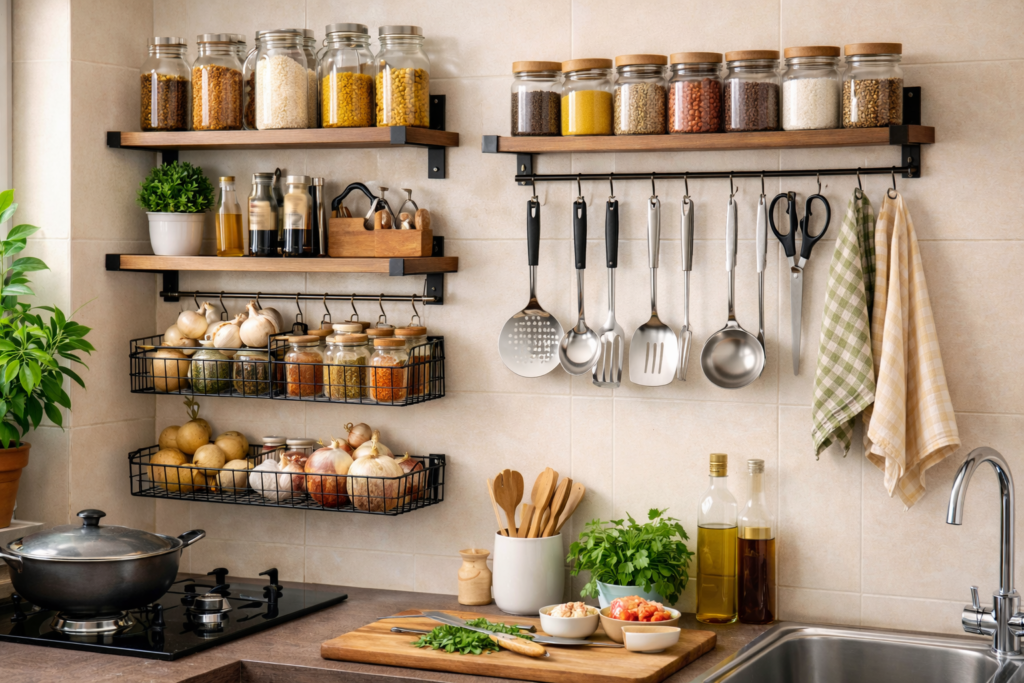
One of the most effective ways to increase storage in a small kitchen is by using vertical wall space. In many homes, the walls above the countertop remain unused even though they can hold a significant number of items.
Installing wall shelves can instantly expand storage capacity. These shelves are ideal for storing spice jars, tea containers, cooking oils, and frequently used ingredients.
Vertical storage also helps keep the countertop clear. When jars and bottles are moved to shelves, more workspace becomes available for food preparation.
Another advantage is convenience. Items placed on wall shelves are easy to see and reach during cooking. Instead of opening multiple cabinets, ingredients remain visible.
When installing shelves, it is important to place them at a comfortable height. Frequently used items should remain at eye level, while less frequently used items can be stored on higher shelves.
Using uniform containers can also make shelves appear more organized. Transparent jars are especially helpful because they allow you to quickly identify ingredients.
Over time, vertical storage can transform the way a small kitchen functions by creating additional space without requiring renovation.
2. Install Open Shelves for Everyday Cooking Items
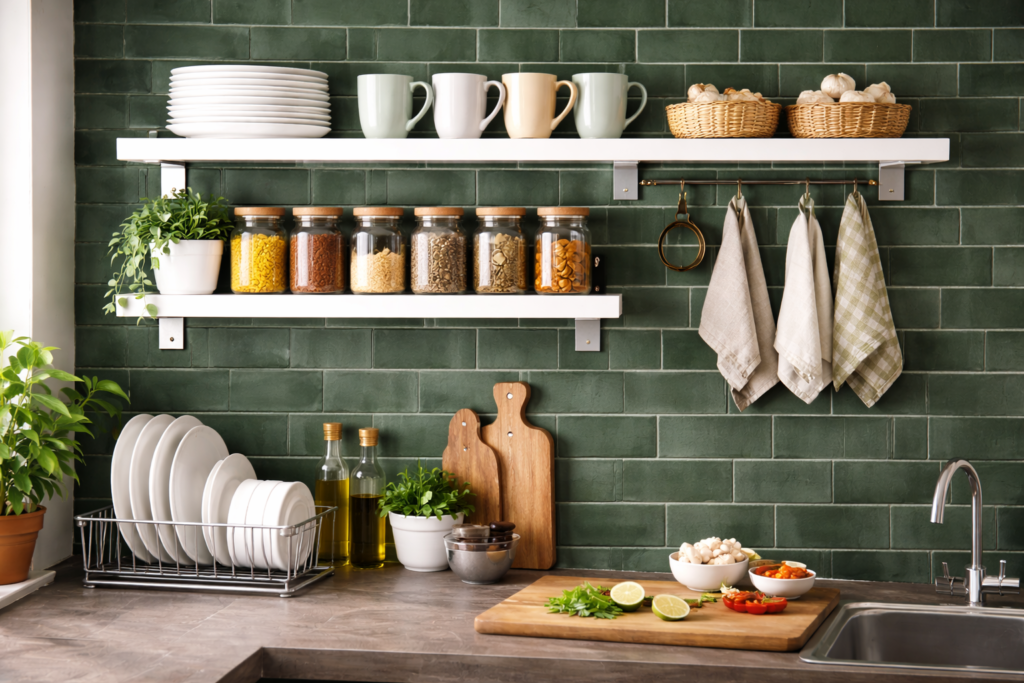
Open shelves are a simple yet effective storage solution for compact kitchens. Unlike closed cabinets, open shelves provide quick access to frequently used items.
Many homeowners prefer storing everyday items such as plates, bowls, cups, and spice jars on open shelves. This reduces the need to open cabinets repeatedly while cooking.
Another benefit of open shelving is that it makes the kitchen appear more spacious. Too many closed cabinets can make a small kitchen feel heavy and crowded. Open shelves create visual openness.
However, maintaining organization is important. Items should be arranged neatly and similar containers should be grouped together.
Using matching jars or containers can also enhance the appearance of shelves while keeping ingredients organized.
3. Hang Utensils Using Hooks or Rails
Cooking utensils such as ladles, spatulas, and spoons can quickly fill drawers and cabinets. Installing hooks or rails on the wall allows these items to be stored vertically.
Hanging utensils keeps them visible and easy to reach during cooking. It also frees up drawer space for other tools.
In busy kitchens where multiple utensils are used simultaneously, having them accessible on the wall can make cooking more efficient.
Rails with movable hooks offer flexibility because utensils can be rearranged easily.
4. Use Corner Shelves That Are Usually Wasted
Corners are one of the most overlooked spaces in small kitchens. In many homes, especially older apartments or builder flats, the corner area between two walls remains completely unused. Cabinets may stop before the corner or the space becomes too awkward to store anything useful.
However, with a little creativity, corners can become one of the most valuable storage areas in a small kitchen.
Corner shelves are an easy solution. These shelves are usually triangular or curved and fit neatly where two walls meet. Even two or three small corner shelves can provide enough space to store several jars, spice containers, or cooking essentials.
One practical way many homeowners use corner shelves is for spice storage. Instead of filling cabinet space with small jars, spices can be placed on corner shelves near the cooking area. This keeps them visible and easy to reach while cooking.
Another advantage is that corner shelves reduce unnecessary movement in the kitchen. When spices or cooking oils are stored close to the stove, you do not need to open cabinets repeatedly during cooking.
Corner shelves are also useful for storing tea, coffee, sugar containers, or condiments that are used regularly. Keeping these items in the corner frees up cabinet space for larger cookware and appliances.
For best results, it helps to install shelves that match the kitchen’s style. Wooden shelves create a warm traditional look, while metal or glass shelves give a modern feel. Regardless of the material, the shelves should be sturdy enough to hold containers safely.
Spacing between the shelves is another important detail. If the shelves are too close together, larger jars may not fit properly. Adjustable shelves are often the best option because they allow flexibility.
In small kitchens, every inch of storage matters. When corners are used properly, they can add a surprising amount of storage without making the kitchen feel crowded.
5. Use Pull-Out Cabinet Organizers
Traditional cabinets often create hidden storage problems. Items stored at the back of a deep cabinet are difficult to reach, which means they are often forgotten or rarely used.
Many people experience this problem when storing cookware. A pressure cooker might be placed at the back of the cabinet, while pans and pots are stacked in front. Each time the cooker is needed, several items must be removed just to reach it.
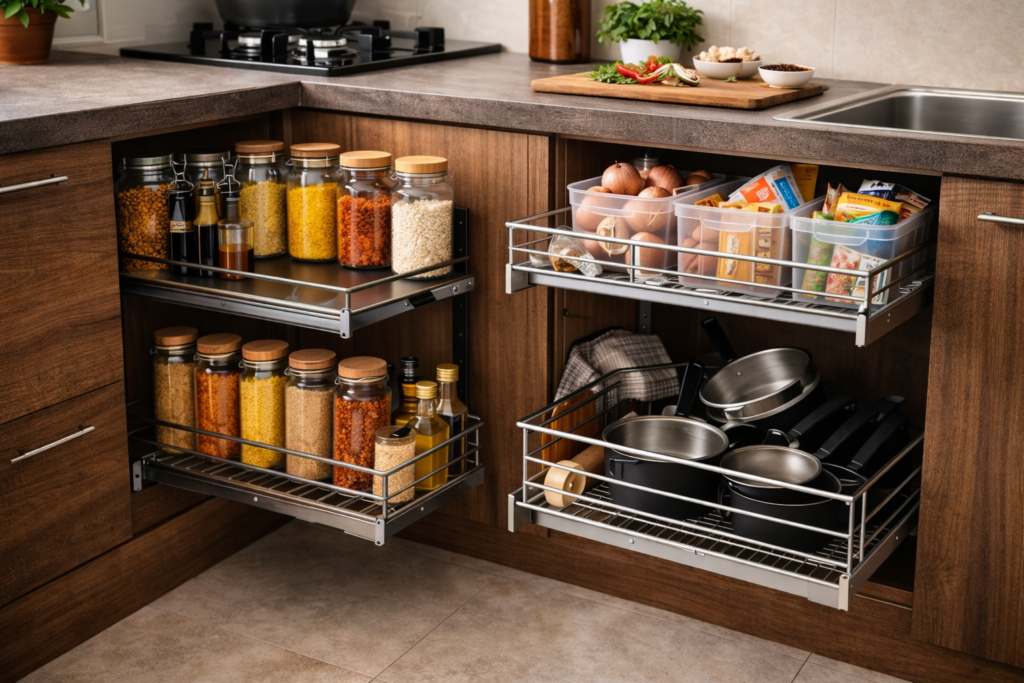
Pull-out cabinet organizers solve this problem by turning a fixed shelf into a sliding one.
Instead of reaching deep inside the cabinet, the entire shelf slides outward, bringing everything into view. This simple design dramatically improves accessibility.
Pull-out shelves work especially well for heavy cookware. Pots, pans, kadai, and pressure cookers can all be stored on these shelves without stacking them dangerously.
Another advantage of pull-out organizers is that they help maintain order inside cabinets. Because everything becomes visible, it is easier to keep items arranged neatly.
Pantry cabinets also benefit greatly from pull-out systems. When storing grains, pulses, and packaged foods, a sliding shelf allows you to quickly see what ingredients are available.
In small kitchens where cabinet space is limited, maximizing accessibility is just as important as maximizing storage.
Pull-out organizers also reduce physical strain. Instead of bending down and searching through cabinets, the shelf moves outward toward you.
This makes everyday cooking tasks smoother and more convenient.
Although installing pull-out systems may require a small investment, many homeowners find that they dramatically improve the usability of their kitchen cabinets.
6. Organize the Space Under the Sink
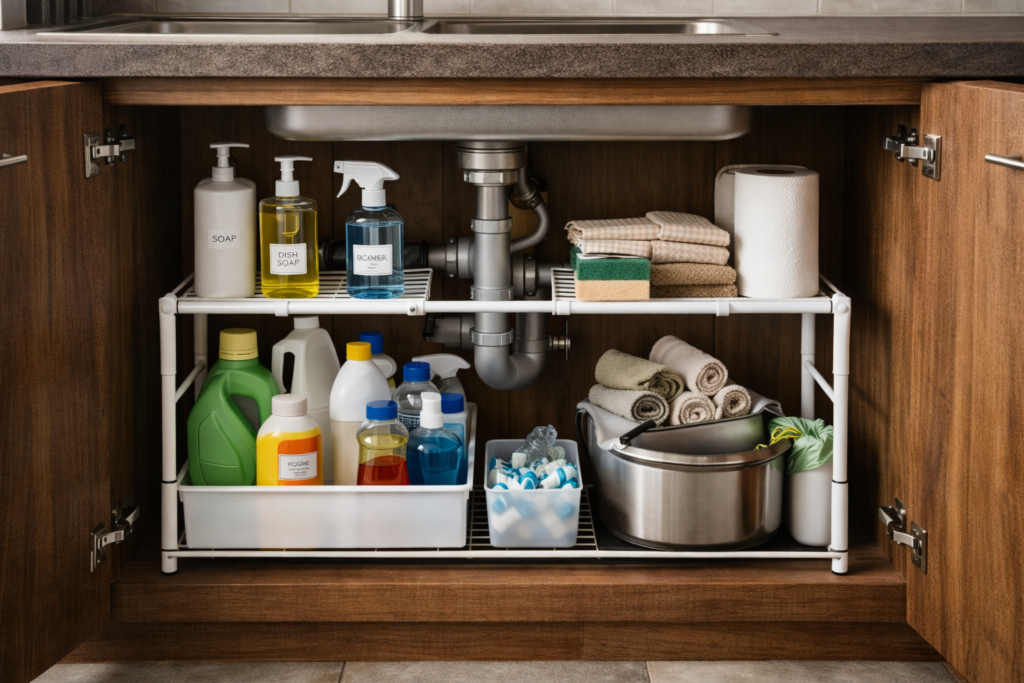
The area under the sink is one of the most commonly disorganized spaces in a kitchen. Pipes, water filters, and irregular cabinet shapes often make it difficult to store items properly.
As a result, cleaning supplies and miscellaneous items are often placed there randomly, creating clutter.
With a little planning, however, the space under the sink can become a highly practical storage area.
The first step is grouping similar items together. Cleaning supplies such as dishwashing liquid, scrubbers, gloves, and cleaning sprays should be kept in one area.
Using small baskets or containers helps prevent these items from spreading across the cabinet.
Stackable racks are particularly helpful under the sink. Because pipes occupy part of the space, racks designed for under-sink storage usually have adjustable sections that fit around plumbing.
These racks create two or three levels of storage instead of leaving the space empty.
Another useful addition is a small tray or waterproof mat at the bottom of the cabinet. This protects the cabinet surface in case of leaks or spills.
Many homeowners also store garbage bags, extra scrubbers, and dishwashing supplies under the sink. Keeping these items here prevents them from occupying cabinets meant for food storage.
In compact kitchens, separating cleaning supplies from food storage areas is important for both hygiene and organization.
When the under-sink cabinet is properly arranged, it becomes easy to find cleaning tools whenever they are needed.
Instead of being a messy hidden corner, this space can function as an organized cleaning station for the kitchen.
7. Use Stackable Containers for Grains and Lentils
In Indian kitchens, grains and lentils are essential ingredients that are used almost every day. Rice, wheat flour, chana dal, moong dal, masoor dal, and many other ingredients are often stored in fairly large quantities. Without proper containers, these ingredients can occupy a lot of cabinet space and make storage difficult.
One of the most practical solutions is using stackable storage containers. These containers are designed so they can sit neatly on top of each other, allowing vertical storage inside cabinets or pantry shelves.
In many households, grains are stored in containers of different shapes and sizes. When these containers are placed together, they create uneven stacks and waste valuable space. Stackable containers solve this problem by maintaining a uniform shape that fits efficiently inside cabinets.
Another advantage of stackable containers is that they help maintain organization. When grains and lentils are stored in separate labeled containers, it becomes easier to find ingredients quickly while cooking.
Transparent containers are particularly useful because they allow you to see the contents immediately. Instead of opening multiple jars to identify an ingredient, you can simply look through the container.
Stackable containers also make it easier to keep track of ingredient quantities. When rice or lentils begin to run low, it becomes visible right away, making it easier to plan grocery shopping.
For small kitchens, vertical stacking is extremely valuable. Instead of spreading containers across multiple shelves, stacking them allows the same cabinet to hold more ingredients.
To maintain order, it is helpful to group similar items together. For example, one section of the cabinet can store grains, another can store lentils, and another can store baking ingredients.
This method creates a clear structure inside the kitchen storage system and prevents ingredients from becoming scattered across different cabinets.
8. Install Storage Inside Cabinet Doors
Many people focus only on shelves and drawers when organizing a kitchen. However, cabinet doors themselves can provide useful storage space.
The inside of cabinet doors often remains empty, even though it can hold several small items when used correctly.
Installing small racks or holders inside cabinet doors allows you to store items that would otherwise occupy shelf space.
For example, spice packets, aluminum foil, plastic wrap, and small kitchen tools can all be stored on door-mounted racks.
This solution is particularly helpful in compact kitchens where every bit of storage matters.
One common problem in small kitchens is that spice packets accumulate quickly. Instead of scattering these packets across cabinets, a door-mounted rack can keep them organized in one place.
Another advantage of door storage is that it keeps frequently used items easy to reach. When the cabinet door opens, the items stored on it become immediately visible.
However, it is important to avoid placing heavy objects on cabinet doors. Lightweight items such as spice packets, cleaning cloths, or small kitchen tools work best.
Door-mounted storage also works well under the sink. A small rack inside the cabinet door can hold cleaning brushes or cloths, keeping them separate from other supplies.
Using cabinet doors for storage is a simple but effective way to increase kitchen capacity without adding new furniture or shelves.
9. Add a Slim Rolling Cart for Flexible Storage
Small kitchens often have narrow gaps between appliances or cabinets. These spaces are usually too small for standard shelves or cabinets, so they remain unused.
A slim rolling cart can turn these narrow gaps into valuable storage areas.
These carts are designed to be narrow enough to fit between appliances such as refrigerators and walls. Despite their slim design, they usually contain multiple shelves for storing kitchen items.
Many homeowners use rolling carts for storing packaged foods, spice bottles, cooking oils, or snack containers.
Because the cart has wheels, it can be pulled out easily whenever something is needed. After use, it can be pushed back into the narrow space where it remains hidden.
Rolling carts are also useful for storing vegetables that do not require refrigeration. Onions, potatoes, and garlic can be stored on ventilated shelves of the cart.
Another benefit of rolling carts is flexibility. Unlike fixed cabinets, these carts can be moved around the kitchen when needed.
For example, when preparing food, the cart can be moved closer to the cooking area so ingredients remain within reach.
When cleaning the kitchen, the cart can also be moved easily to access the floor behind it.
For small kitchens where storage options are limited, a rolling cart provides both additional space and mobility.
It is one of the simplest ways to utilize narrow gaps that would otherwise remain empty.
10. Use Drawer Dividers to Keep Utensils Organized
Kitchen drawers often become one of the most cluttered places in a small kitchen. When spoons, knives, peelers, scissors, and other small tools are placed together without any structure, the drawer quickly turns into a mix of items that are difficult to sort through.
Many people experience the same situation: opening the drawer to find a spoon or knife but needing to search through several tools before finding the right one. This may seem like a small inconvenience, but when it happens several times during cooking, it slows down the entire process.
Drawer dividers are a simple solution that can dramatically improve kitchen organization.
These dividers create separate compartments inside the drawer. Each compartment can hold a specific type of utensil. For example, one section may hold spoons, another forks, another knives, and another small tools such as peelers or bottle openers.
Once utensils are separated, the drawer becomes much easier to use. Every item has a fixed place, which means you no longer need to search through a pile of tools.
Drawer dividers are especially helpful in small kitchens because they maximize the use of limited drawer space. Instead of stacking utensils on top of each other, they allow everything to remain visible and accessible.
Another advantage is cleanliness. When utensils remain separated, it becomes easier to keep the drawer clean and organized.
For best results, it helps to occasionally review the items stored in the drawer. Many kitchens accumulate tools that are rarely used. Removing unnecessary items creates more space and makes the drawer easier to maintain.
Even though drawer dividers are a small addition, they can significantly improve everyday kitchen efficiency.
11. Keep Frequently Used Items Near the Cooking Area
One of the most practical principles of kitchen organization is storing items based on how often they are used.
In many kitchens, ingredients and tools are placed randomly inside cabinets. This means frequently used items may end up stored far away from the cooking area.
When this happens, cooking becomes inefficient because you need to move across the kitchen repeatedly to find ingredients or tools.
A better approach is organizing the kitchen around cooking zones.
The cooking zone usually includes the stove, nearby counter space, and the cabinets closest to that area. Items that are used regularly during cooking should be stored in this zone.
For example, spices, cooking oils, salt, and frequently used utensils should remain close to the stove. This allows you to access them quickly while cooking.
Keeping essential items nearby also improves cooking flow. When everything is within reach, you can focus on the cooking process rather than searching for ingredients.
Another benefit of organizing items by frequency of use is that it reduces cabinet clutter. Items that are rarely used, such as special cookware or seasonal appliances, can be stored in higher cabinets or deeper storage areas.
This leaves the most accessible storage spaces available for everyday cooking essentials.
Professional chefs often follow this principle in restaurant kitchens because it allows them to work efficiently in a limited space.
Even in a small home kitchen, applying this simple rule can make cooking smoother and more enjoyable.
12. Declutter the Kitchen Regularly
No matter how well a kitchen is organized, clutter can slowly return over time. New containers, utensils, and appliances gradually accumulate, and cabinets begin to fill again.
Decluttering regularly is an important habit for maintaining an organized kitchen.
Many kitchens contain items that are rarely used. Duplicate utensils, old containers, or appliances that have not been used for months often occupy valuable storage space.
Reviewing kitchen cabinets every few months can help identify these items.
If a tool or container has not been used in a long time, it may be worth removing it from the kitchen. Donating unused items or storing them elsewhere can create more room for essential tools.
Decluttering also helps improve visibility inside cabinets. When cabinets contain only necessary items, it becomes easier to find ingredients and cookware.
Another benefit of decluttering is that it encourages better organization habits. When people become more aware of what they own, they are less likely to purchase duplicate items unnecessarily.
For small kitchens, maintaining minimal clutter is one of the most effective ways to preserve space.
Even a few minutes spent organizing cabinets occasionally can keep the kitchen functioning smoothly.
Simple Changes That Make a Small Kitchen Easier to Use
A small kitchen does not have to limit how comfortably you cook. With thoughtful planning and practical storage solutions, even a compact kitchen can become highly efficient.
The key is using every available space wisely. Walls, corners, cabinet doors, and narrow gaps can all become useful storage areas when organized properly.
Simple improvements such as installing shelves, using stackable containers, and organizing utensils can make a noticeable difference in daily cooking routines.
Over time, these small changes create a kitchen environment that feels less crowded and more enjoyable to work in.
An organized kitchen also saves time and energy. When ingredients and tools are easy to find, cooking becomes faster and less stressful.
Ultimately, the size of a kitchen matters far less than how well the space is used. With smart storage ideas and regular organization habits, even a tiny kitchen can become a functional and welcoming space for everyday cooking.
Frequently Asked Questions
How do you organize a very small kitchen with limited cabinets?
Start by using vertical storage instead of relying only on cabinets. Wall shelves, hanging utensil racks, and magnetic knife holders can free up cabinet space. Inside cabinets, stackable containers and pull-out organizers help store more items without creating clutter.
Another useful approach is grouping similar items together. For example, store all spices in one area, grains in another, and cookware in a separate cabinet. This makes it easier to find items quickly while cooking.
What is the best way to store spices in a small kitchen?
Spices should be stored where they are easy to reach during cooking. Many people place spice racks on the wall near the stove or inside cabinet doors.
Transparent spice jars are helpful because they allow you to identify spices quickly. Keeping spices organized in one location also prevents duplicate purchases and saves time when cooking.
How can I make my small kitchen look bigger?
A small kitchen can appear larger by reducing visual clutter. Keeping countertops clean, organizing containers neatly, and using open shelves can create a more spacious feel.
Light-colored cabinets and good lighting also help reflect light, making the kitchen feel brighter and more open.
What items should not be kept on the kitchen counter?
To keep the workspace clear, avoid storing too many appliances or containers on the counter. Items such as extra jars, unused utensils, and packaged foods should be stored inside cabinets.
Ideally, the countertop should hold only the most frequently used items like a spice container or cooking oil.
How do I store grains and lentils efficiently in a small kitchen?
Using stackable airtight containers is the most efficient method. These containers allow ingredients to be stored vertically and protect them from moisture or pests.
Labeling containers also helps identify ingredients quickly, especially when storing several types of lentils or grains.
How can I add storage to a kitchen without renovation?
You can increase storage without remodeling by installing wall shelves, hanging utensil racks, cabinet door organizers, and slim rolling carts.
These additions require minimal installation but can significantly increase storage capacity in a compact kitchen.
How often should a kitchen be decluttered?
A good habit is reviewing kitchen storage every two to three months. Removing unused containers, duplicate utensils, or expired ingredients helps maintain an organized space.
Regular decluttering also prevents cabinets from becoming overcrowded.
What are the most common storage mistakes in small kitchens?
Some common mistakes include overcrowding cabinets, storing rarely used appliances on the countertop, and ignoring vertical wall space.
Avoiding these habits helps maintain better organization and improves the overall efficiency of the kitchen.