Induction vs Gas Stove: Which Is Cheaper for Indian Households?
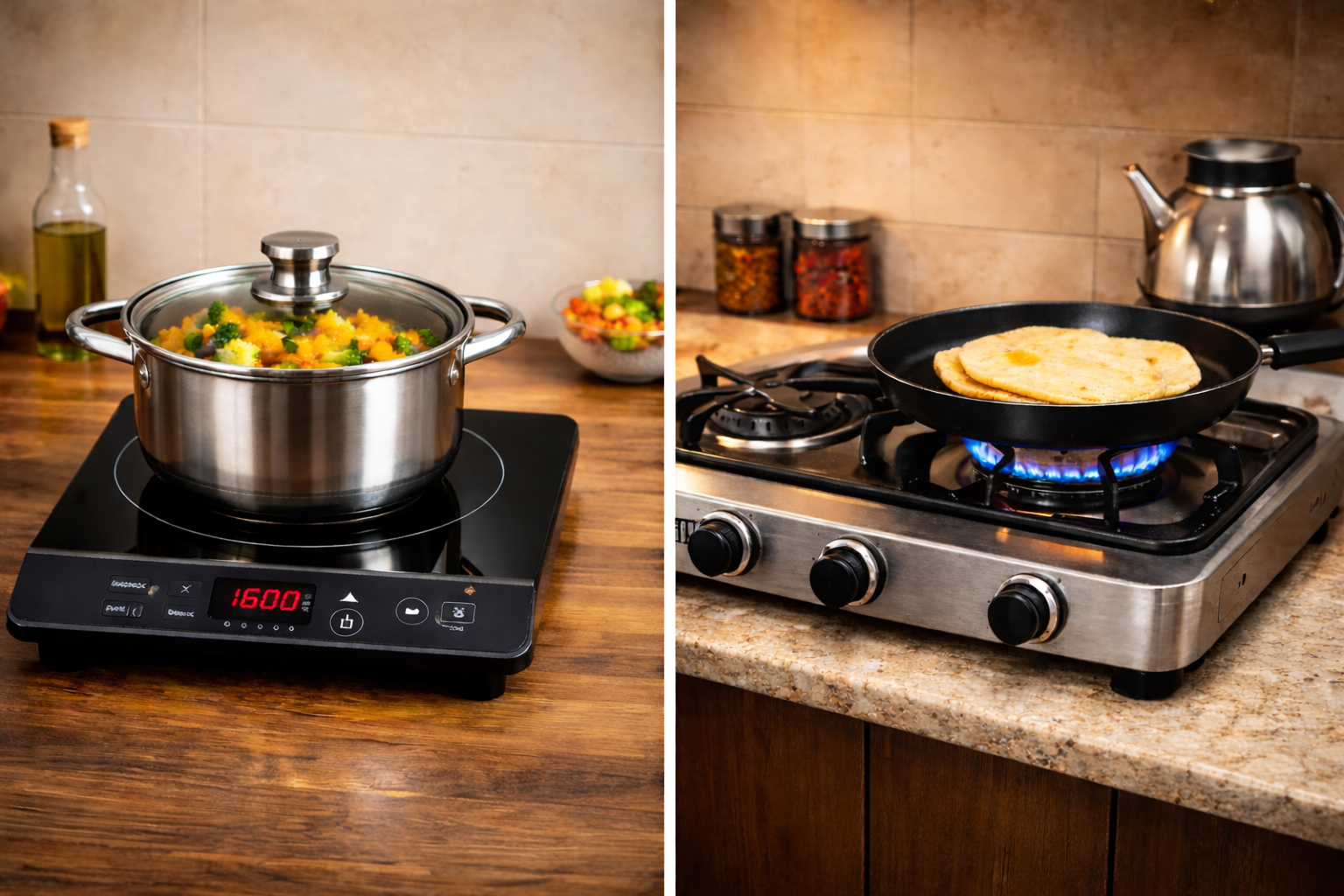
Choosing between an induction cooktop and a gas stove is a common question for Indian households. While gas stoves have been used for decades, induction cooktops are becoming popular due to rising LPG prices and electricity availability.
In this article, we compare induction vs gas stove purely on cost for Indian homes, including running cost, installation cost, and long-term savings, to help you decide which option is cheaper.
Initial Cost: Induction Cooktop vs Gas Stove
The initial cost is the first expense Indian households consider before buying a cooking appliance.
A basic gas stove usually costs less than an induction cooktop. A two-burner gas stove is affordable and widely available in local markets. In contrast, an induction cooktop generally costs more upfront, especially if you choose a branded model with safety features.
However, induction cooktops do not require a gas connection, cylinder, or regulator, which slightly balances the initial expense.
Running Cost Comparison in India
Running cost is where the real difference appears between induction cooktops and gas stoves.
Gas stoves depend on LPG cylinders, and the price of LPG has increased steadily in India. Monthly cooking expenses can rise if a household cooks frequently.
Induction cooktops use electricity. Although electricity prices vary by state, induction cooking is generally more energy-efficient. Since induction transfers heat directly to the cookware, less energy is wasted compared to gas stoves.
Monthly Cost Comparison: Induction vs Gas Stove in India
For most Indian households, the real question is not just convenience but monthly cooking cost. Let’s break this down using realistic Indian usage.
🔌 Induction Cooktop – Monthly Electricity Cost
An average induction cooktop uses 1200–2000 watts.
Most Indian households cook 2–3 hours per day.
Calculation (average use):
Power usage: 1.5 kW
Daily use: 2 hours
Monthly units = 1.5 × 2 × 30 = 90 units
Electricity cost in India:
₹6–₹8 per unit (varies by state)
Monthly induction cost:
₹540 – ₹720 per month
If you cook more (3 hours/day), cost can reach ₹900+ per month.
🔥Gas Stove – Monthly LPG Cost
Most Indian homes use a 14.2 kg LPG cylinder.
Average LPG usage:
1 cylinder lasts 30–45 days
Current LPG price (India average): ₹900 – ₹1100
Monthly gas cost:
₹650 – ₹900 per month
Heavy cooking households may use 1.5 cylinders per month, increasing cost to ₹1400+.
Monthly Cost Summary
Induction cooktop: ₹540 – ₹900
Gas stove: ₹650 – ₹1400
On average, induction cooking appears cheaper, but actual cost depends on electricity tariff and cooking habits.
Important Reality for Indian Homes
Induction cooktops do not work during power cuts.
High electricity slabs can increase cost.
Gas stoves work without electricity and remain reliable.
This is why many Indian households use both induction and gas together.
Yearly Cost Comparison: Induction vs Gas Stove
To understand which option is cheaper in the long run, it is important to compare the yearly cooking cost for an average Indian household.
Yearly Cost of Using an Induction Cooktop
Based on the earlier calculation, an induction cooktop consumes around 90 units of electricity per month for regular cooking.
Yearly electricity consumption:
90 units × 12 months = 1080 units per year
If the average electricity cost is ₹6–₹8 per unit, the yearly cost will be:
₹6 per unit → ₹6,480 per year
₹8 per unit → ₹8,640 per year
So, the yearly induction cooking cost usually falls between:
₹6,500 – ₹8,600 per year
This cost can increase if cooking hours are longer or if electricity tariffs are higher in your state.
Yearly Cost of Using a Gas Stove
A typical Indian household uses around 10 to 15 LPG cylinders per year, depending on cooking habits and family size.
If one LPG cylinder costs around ₹900 – ₹1100:
10 cylinders per year:
₹9,000 – ₹11,000 per year
15 cylinders per year:
₹13,500 – ₹16,500 per year
So, the yearly gas cooking cost usually ranges between:
₹9,000 – ₹16,500 per year
Yearly Cost Summary
Induction cooktop yearly cost: ₹6,500 – ₹8,600
Gas stove yearly cost: ₹9,000 – ₹16,500
In many cases, induction cooking is cheaper on a yearly basis, especially for small to medium-sized families. However, reliability during power cuts and electricity slab rates should also be considered.
Maintenance and Hidden Costs: Induction vs Gas Stove
Apart from monthly and yearly running costs, Indian households should also consider maintenance expenses and hidden costs before choosing between an induction cooktop and a gas stove.
Maintenance Cost of an Induction Cooktop
Induction cooktops generally require very little maintenance. There are no burners, pipes, or gas connections involved. Regular cleaning of the glass surface is usually enough.
However, induction cooktops depend on electricity and electronic components. If the internal circuit fails after the warranty period, repair costs can be high. Also, induction cooking requires compatible flat-bottom cookware, which can add to the initial expense if you do not already own such utensils.
Maintenance Cost of a Gas Stove
Gas stoves require periodic maintenance. Burners can get clogged due to oil and food residue, and rubber gas pipes need replacement every few years for safety reasons.
There may also be additional costs for:
– Gas regulator replacement
– Gas pipe replacement
– Stove servicing
While individual repair costs are usually low, maintenance expenses can add up over time.
Hidden Costs to Consider
Induction cooktops may increase your electricity bill slab, pushing you into a higher tariff bracket in some states. On the other hand, gas stoves rely on LPG availability, and price hikes directly affect monthly expenses.
Both options have hidden costs, but gas stoves tend to have more frequent small maintenance expenses, while induction cooktops may have occasional but higher repair costs.
Pros and Cons of Induction Cooktop and Gas Stove
Understanding the advantages and disadvantages of both options helps Indian households make a practical decision based on daily cooking needs.
Pros of Induction Cooktop
– Energy efficient and cooks food faster
– Lower yearly running cost in many Indian cities
– Easy to clean due to flat glass surface
– Safer option with no open flame
– Better temperature control for modern cooking
Cons of Induction Cooktop
– Does not work during power cuts
– Requires induction-compatible cookware
– Repair costs can be high if electronic parts fail
– Electricity slab increase may raise bills in some states
Pros of Gas Stove
– Works even during power cuts
– Suitable for all types of Indian cookware
– Familiar cooking style for Indian households
– Easier and cheaper repairs
– Strong flame control preferred for some dishes
Cons of Gas Stove
– Rising LPG prices increase monthly cost
– Heat loss makes it less energy efficient
– Regular maintenance required for safety
– Open flame increases fire risk if mishandled
Which Is Cheaper: Induction or Gas Stove for Bachelors and Families?
If you are planning to reduce cooking costs, a basic induction cooktop can be a practical option for many Indian households.
The cheaper option between an induction cooktop and a gas stove also depends on household size and cooking habits in India.
For Bachelors and Small Families
For bachelors, students, and small families with light to moderate cooking needs, induction cooktops are often the cheaper option. Cooking is usually limited to boiling, frying, or reheating food for short durations.
Since daily cooking time is lower, electricity consumption remains controlled, and the monthly cost stays affordable. Induction cooktops also save space and are easy to maintain, making them suitable for rented homes and small kitchens.
For Medium to Large Families
For medium to large Indian families, gas stoves can sometimes be more practical. Long cooking hours, multiple dishes, and frequent use may increase electricity consumption significantly when using an induction cooktop.
Gas stoves handle heavy cooking better without worrying about power cuts or electricity slab increases. In such cases, gas may not always be cheaper, but it offers reliability and flexibility for daily Indian cooking.
Best Practical Choice for Indian Homes
Many Indian households use a combination of both options. An induction cooktop is used for light cooking and reheating, while a gas stove is reserved for heavy cooking. This balanced approach helps control costs while ensuring uninterrupted cooking.
FAQs: Induction vs Gas Stove in India
Is induction cooktop cheaper than gas stove in India ?
In many cases, induction cooktops are cheaper for small households due to better energy efficiency. However, costs depend on electricity rates and cooking duration.
How much electricity does an induction cooktop consume daily ?
On average, an induction cooktop consumes about 2–3 units of electricity per day for normal Indian cooking.
Does induction cooking increase electricity bill a lot ?
Electricity bills may increase slightly, especially if cooking hours are long or if usage pushes the household into a higher tariff slab.
Is gas stove still better for Indian cooking ?
Gas stoves are preferred for heavy cooking, traditional dishes, and areas with frequent power cuts.
Can induction and gas stove be used together ?
Yes, many Indian homes use both to balance cost, convenience, and reliability.
Final Verdict: Induction vs Gas Stove – Which Is Cheaper?
There is no single answer that fits every Indian household. Induction cooktops can be cheaper in the long run for bachelors and small families due to lower yearly running costs and energy efficiency. Gas stoves, on the other hand, remain reliable for large families and heavy cooking needs.
The best choice depends on electricity availability, cooking habits, and family size. For many homes, using both induction and gas together offers the most practical and cost-effective solution.