How Kitchen Wiring Affects Induction Performance
Kitchen wiring affects induction performance in many Indian homes more than people realise.Most induction problems in Indian homes start with the same situation.The induction cooktop is from a good brand, but it does not heat properly.
Sometimes it cooks fast. Sometimes it feels weak.
• Milk stops boiling midway.
• Dal takes longer than expected.
• The cooktop switches off suddenly.
Naturally, the induction cooktop gets blamed first. Some people blame the utensils. Others say induction is not suitable for Indian cooking and return to gas.
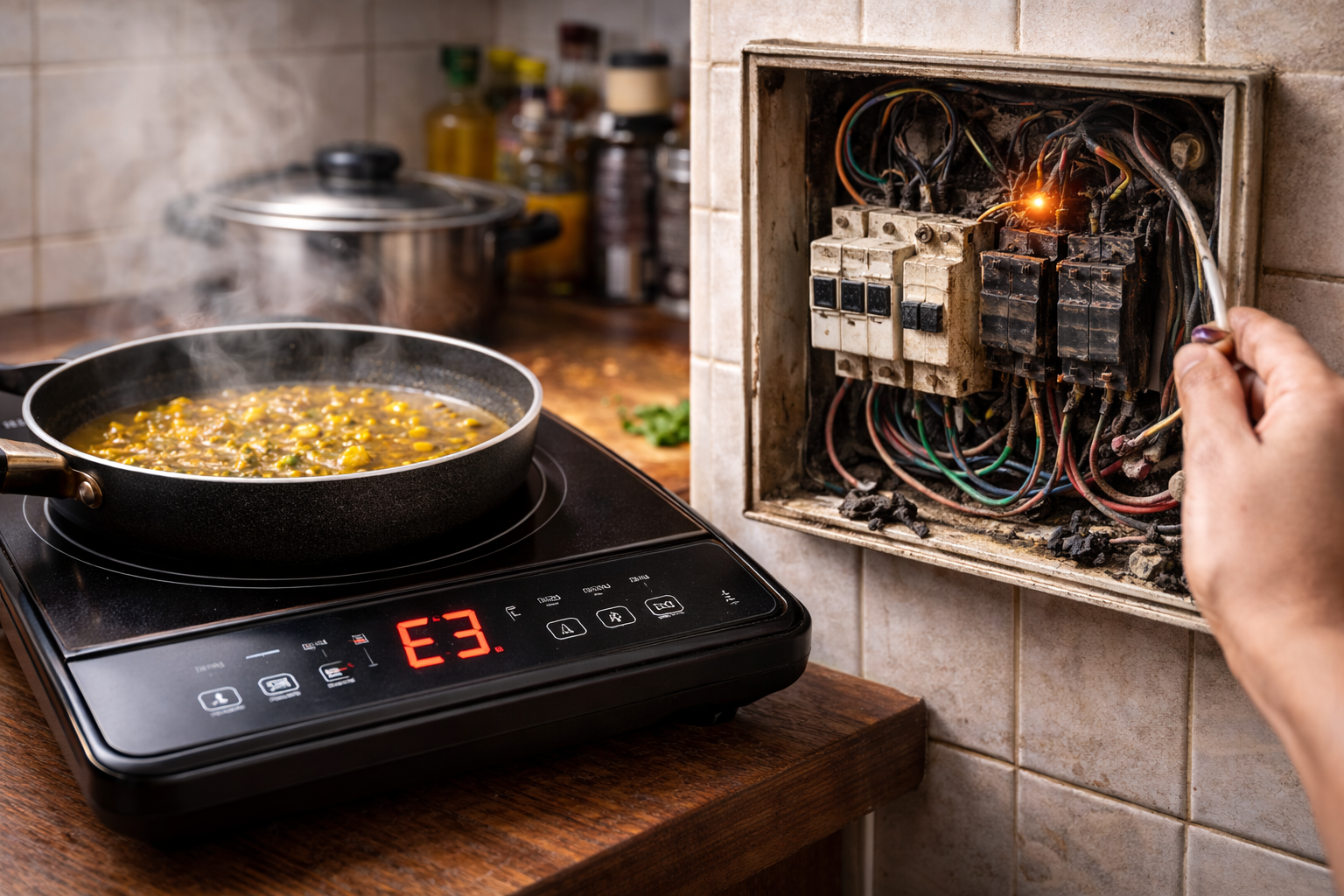
In many cases, the induction cooktop is not the real problem.The real issue is the kitchen wiring.Because wiring is hidden inside walls, it is easy to ignore. The induction turns on, the display works, and cooking happens slowly, so it feels like the appliance is functioning. But induction cooktops are far more sensitive to power quality than gas stoves or basic kitchen appliances.Small wiring issues that do not affect other devices can seriously reduce induction performance.
If your induction heats slowly, shuts down randomly, shows errors, or behaves differently in different homes, kitchen wiring is usually the reason.
Why kitchen wiring affects induction performance
An induction cooktop works very differently from a gas stove.A gas stove burns fuel and produces a flame. Even if gas pressure is low, the flame still burns.
An induction cooktop depends completely on electricity. It needs stable voltage and strong current flow to generate heat efficiently. If the power supply drops even slightly, the induction reduces output or shuts down to protect itself.
In many Indian homes, wiring was never designed for high-power cooking appliances. Most houses were built when kitchens used only gas stoves. Electrical lines were planned for lights, fans, and small appliances.Thin wires, loose connections, weak sockets, shared power lines, and poor earthing are common. These problems may not affect a mixer or refrigerator, but an induction cooktop exposes them immediately.
That is why the same induction works perfectly in one house and struggles in another.
How wiring problems show up during daily cooking
Most people do not realise these signs point to wiring issues.
You may notice:
• Water takes too long to boil
• Milk stops heating suddenly
• The cooktop beeps and switches off
• Power level drops on its own
• Cooking works better late at night
• Food cooks unevenly
• The base of the cooktop feels very hot
• The wall socket becomes warm
These issues are often assumed to be normal induction behaviour.They indicate that the induction cooktop is not receiving proper power.This is another reason kitchen wiring affects induction performance during daily cooking.
Common wiring issues and what they cause
| Kitchen wiring issue | What you notice during cooking |
| Old or thin wiring | Slow heating |
| Loose wall socket | Sudden shut-off |
| Extension board usage | Uneven cooking |
| Voltage fluctuation | Error messages |
| Poor earthing | Safety shutdown |
| Shared power line | Reduced performance |
| Weak circuit breaker | Breaker trips |
This explains why induction often feels slower than gas in real kitchens, similar to how pressure cooker efficiency vs gas consumption changes depending on usage conditions.
Is it dangerous or safe
An induction cooktop is safe only when the wiring is proper.When wiring is weak or overloaded, risks increase over time. These include overheating sockets, melting plugs, internal stress on the cooktop, electric shock in rare cases, and fire risk in extreme situations.
Most safety issues linked to induction cooking are caused by poor wiring, not by the appliance itself.
If the induction heats slowly, the socket becomes hot, and an extension board is used, the setup is unsafe for long-term use.
This does not mean induction cooking is unsafe. It means the electrical setup is unsafe.Just like a gas stove needs a proper regulator and pipe, an induction cooktop needs proper wiring.
The reality of Indian kitchen wiring
Many Indian kitchens are more than ten years old. The wiring was done when gas stoves were the only cooking method. One socket often runs multiple appliances such as mixers, refrigerators, water purifiers, and induction cooktops.
Dedicated power lines are rare. Earthing is often ignored during construction.
Builders focus on visible elements like tiles and cabinets. Wiring quality usually receives little attention.
This is why induction performance varies so much across homes and why some families feel induction works well for others but not for them.
Voltage fluctuation and induction behaviour
Voltage fluctuation is common in many areas, especially during summer afternoons, rainy seasons, or in older buildings.When voltage drops, the induction cooktop automatically reduces power or shuts off to protect its internal components. This slows cooking and causes interruptions.
Gas stoves are unaffected by voltage. Induction cooktops are not.This is why many people notice that induction works better late at night, when voltage supply is more stable.
Power rating and wiring mismatch
Most induction cooktops in India are rated between 1800 and 2200 watts.
However, many kitchen sockets are connected using thin wires that cannot safely handle this load for long periods.
For proper performance, an induction cooktop needs thick copper wiring, a dedicated socket, and a high-capacity switch.
Without this setup, the induction never reaches its full potential. This is why gas cooking sometimes feels faster, even though induction is efficient on paper.
Efficiency numbers only matter when power supply conditions are correct.
What you can do at home
You do not need to renovate your kitchen immediately. Start with simple checks.
1. After cooking for ten to fifteen minutes, touch the wall socket carefully. Slight warmth is normal. Excessive heat is a warning sign.
2. Avoid using extension boards or multi-plugs. Always plug the induction directly into the wall socket.
3. Ask an electrician about the wire thickness connected to the kitchen socket. Thin wiring is a common problem.
4. If possible, install a separate power line from the circuit breaker to the induction socket. This single step improves performance and safety.
5. Ensure proper earthing. Good earthing protects the appliance and improves stability.
Observe cooking behaviour after making these changes. If performance improves, the issue was wiring-related.
Common misunderstandings
Many people believe changing the brand will solve induction problems. In most cases, the problem continues if wiring is not fixed.Some think induction cooktops are naturally slow. Poor power supply is usually the real reason.
Others focus only on utensil quality. Wiring quality matters more than utensils.
Higher wattage induction cooktops are often seen as a solution, but they actually increase stress on weak wiring.
When to stop using or replace
Stop using the induction immediately if you notice sparks, burning smells,repeated circuit breaker trips, frequent shut-downs, or electric shock sensations.These signs should never be ignored.Consider rewiring if the house wiring is very old, the kitchen has never been upgraded, or multiple high-power appliances share the same line.Replace the induction cooktop only if the wiring is proper and the appliance still fails after inspection.
Most people replace the cooktop first. That is usually the wrong step.
Why wiring matters more than the cooktop
Induction cooktops are not weak.
Many Indian kitchen wiring systems are.
Most induction complaints are caused by power supply issues, not by the appliance itself.
Before blaming the brand, the utensil, or the technology, look behind the switchboard.
Wiring may be invisible, but its impact is felt every day during cooking.
Fix the foundation first. Cooking becomes easier, faster, and safer after that.